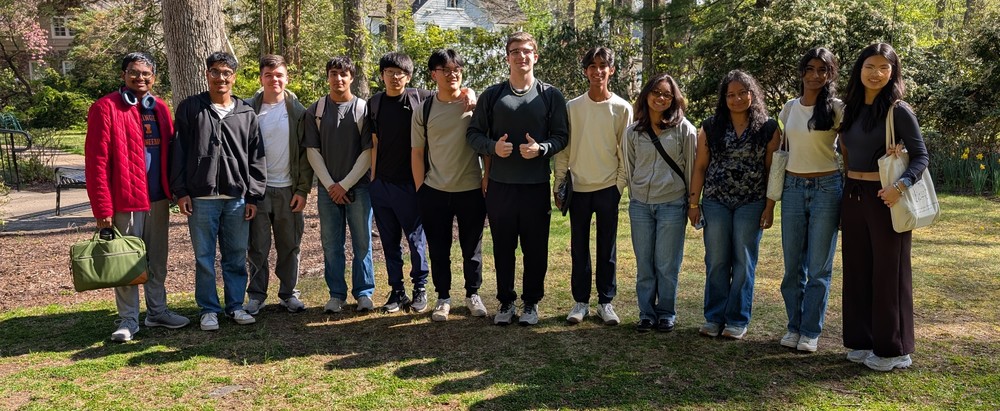
Twelve AP Physics students from Bridgewater-Raritan High School participated in the 2026 MINERva Masterclass, held at Drew University in Madison on Saturday, April 18.
Bridgewater-Raritan High School Physics Teachers, Dr. Eleni Arapaki and Fangze Shang, accompanied the students to the event, which was sponsored by QuarkNet and Drew University. QuarkNet Center.
The 12 Bridgewater-Raritan High School students who participated at Drew University were AP Physics 1 students Luhang Liu, Sophia Hom, Kairav Mehta, Juliana Narciso, Aishani Uddaraju, and Max Weinstein, AP Physics 2 students Parth Advani and Nicholas Persson, and AP Physics C students Shreya Gupta, Suyash Gupta, Tejas Somasekar, and Bryan Zou.
Dr. Arapaki reported on the day's events.
“The students arrived at the Ehinger Center, where they attended a presentation given by Professor Benslama on neutrinos, ghostly particles that pass through ordinary matter almost entirely undetected.”
“The academic rigor increased as the morning progressed, featuring a specialized session on Artificial Intelligence and Particle Physics with Professor Rudniy. This session highlighted how modern physicists use machine learning to sift through the massive amounts of data generated by particle accelerators.”
“After a collaborative lunch with Drew faculty, physics students and teachers from local schools, the Bridgewater-Raritan High School participants transitioned from listeners to researchers. The students performed a MINERvA masterclass measurement. Using real data from Fermilab, the students analyzed neutrino interactions, recording their findings in a global data spreadsheet to see if their results aligned with theoretical predictions.”
Dr. Arapaki explained MINEErva.
“MINERvA (Main INjector Experiment for ν-A interactions) is a neutrino-scattering experiment at Fermilab that uses the intense NuMI beamline to make high-precision measurements of how neutrinos interact with different nuclei such as helium, carbon, iron, lead and more. It is uniquely designed with a finely segmented scintillator detector placed underground in front of the MINOS near detector to capture and analyze thousands of neutrino collisions in the 1–10 GeV energy range, providing essential data on neutrino-nucleus cross sections and nuclear effects that improve our understanding of neutrino behavior and support current and future oscillation experiments like DUNE. MINERvA’s results also offer insights into proton and nuclear structure and help reduce uncertainties in neutrino physics analyses”.
Dr. Arapaki said that the session closed with this segment.
“The event concluded with a live videoconference with Fermilab moderators. Our students discussed their results, asked questions about careers in high-energy physics, and saw how their small group data contributed to the larger scientific picture. The event was supported by the National Science Foundation and the U.S. Department of Energy.”